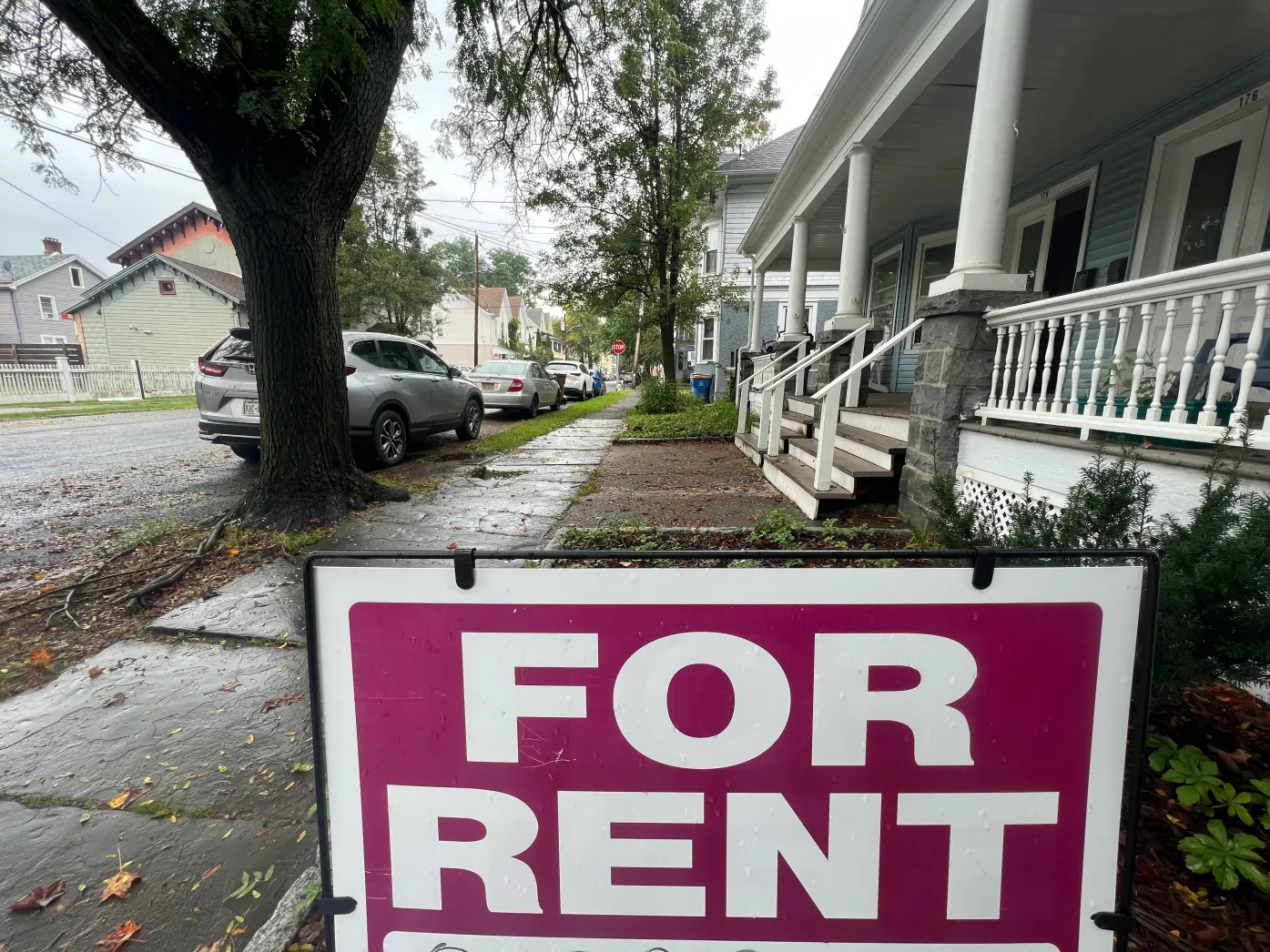
Hudson Valley Pattern for Progress is a non-profit organization that investigates regional issues like housing, transportation, the local economy and community development, and proposes solutions based on data in order to improve the quality of life in the Hudson Valley. The presentation was led by Elka Gotfryd, the executive director of the Center for Housing Solutions and Community Initiatives and senior urban planner at Pattern for Progress. More members of the organization, such as Robin DeGroat, vice president of operations, among others were also in attendance.
The AMI is the median point of income of all households in the region. It isn’t a simple average, but rather a more thought-out statistic created to avoid the highest earnings that would distort the calculation. In theory it seems reasonable, but in practice, this number is used to set thresholds like 50%, 80% or 100% of the AMI, that later determine the eligibility for subsidized housing, developments with tax credits or homeownership programs. The problem is that this indicator mixes income of property owners with that of tenants, even though many of these programs are directed towards people who rent and generally earn significantly less.
“AMI is so embedded in that we have something that’s not going to disappear. How can we use this in our favor?”, explained Gotfryd during the presentation.
In concrete terms, the AMI varies based on the county, the program and the size of each home. According to the income limits used for accessible housing programs in 2025, for a family of four, 80% of the AMI is approximately $98,400 annually in Orange and Dutchess, and $95,840 in Ulster. From another vantage point, 50% of the AMI is about $61,500 in
Orange and
Dutchess, and $59,900 in
Ulster. If we take as reference 100% of the AMI, the approximate annual income would be $123,000 in Orange and Dutchess, and $119,800 in Ulster.
In housing, this translates to what is considered “affordable”. A common rule establishes that a family shouldn’t spend more than 30% of their earnings on rent. This means that, at 100% of the AMI in Ulster, an “affordable” rent would be around $2,995 monthly; at 80% of the AMI, around $2,396; and at 50% of the AMI, approximately $1,498. In Orange and Dutchess, at 100% of the AMI, am “affordable” rent would be around $3,075 monthly; at 80%, around $2,460; and at 50%, around $1,538.
Nevertheless, Pattern for Progress signaled in their report
“Out of Reach 2025” that many programs continue to use 80% of the AMI as reference, even though the majority of those renting and working in the area make below 50% of the AMI. The same report concludes that, in various counties, the cost of rent and food already surpass what local salaries can pay.
This was exactly one of the most fiercely debated points. Gotfryd signaled that although official language uses the word “affordable”, the daily experience of many families says otherwise.
This subject resonates in particular with the Latino community, because in the Mid-Hudson Valley, the Hispanic and Latino population has grown at a sustained rate since the 2000s in all seven counties in the region. In cities like Newburgh, the Latino population represents more than half of residents. This growth has helped sustain communities, schools, businesses and job markets, but this has also occurred in a region where housing options have not grown at the same rate as that necessity.
And so, the question isn’t only how many people have arrived, but rather what type of housing they encounter. In New York, according to the
Center for Migration Studies many Latino immigrant families work in restaurants, cleaning, construction, care, agriculture, warehouses, transportation and other essential sectors, which is to say, they sustain a significant part of the regional economy, but not always with salaries that align with the cost of living. When the standard of “affordability” is defined by a formula that inflates average income by including landlords with the most resources, the result is many “affordable” units that are out of reach for those who really need them. This was one of the central critiques brought up at the event “Measuring Affordability”.
Moreover, data from the state shows that Hispanic and Latino families tend to confront higher living costs than white non-Hispanic households. New York State Homes and Community Renewal, or HCR is the state agency in New York that administers accessible housing programs, subsidies, loans and assistance so that more families can rent, buy or keep a stable home. Their report “Fair Housing Matters NY” shows that Hispanic and Latino families experience the burden of higher living costs, an inequality that is exacerbated when combined with low salaries, discrimination and a shortage of available units.
The required taxes for some property owners are also added which requires earnings equivalent to three times the rent. These requirements can appear to be routine filters, but in reality, they can exclude people with housing subsidies and workers whose income is not sufficient to pay rent with public assistance, but they can’t reach those private thresholds.
Another, less visible but more concrete, problem is the “edge” of eligibility. Which is to say, when someone receives a raise and, instead of being able to better their situation, they’re left outside the range permitted to keep their affordable housing. Gotfryd said that in the case of municipal mandates, an option could be to permit the person to whom the unit pertains once subsequently and readjust the level of affordability once that apartment is vacant again. She also mentioned more gradual scales of affordability as a resource to avoid abrupt changes.
Another question posed directly at the validity of the AMI is if another form of adjusting the formula exists to better reflect the local economic reality. Gotfryd responded that the first step would be to look at hyperlocal data and separate the income of renters from property owners, because mixing both artificially inflates the index when in reality these programs are designed for and directed primarily towards renters.
Other regions in the country were also discussed, where building housing is cheaper, and if a replicable model could be offered in the Hudson Valley. Gotfryd recognized that the region hasn’t always looked towards other parts of the country and noted that it would be useful to understand successful practices throughout the nation, especially in regards to more economic construction, modular housing, pre-fabricated models, renovation of existing buildings and the differences between for-profit and non-profit developments.
The reality is that we can’t pretend that the AMI is going to disappear overnight. One of the conclusions of the conversation is the idea of working with the system that already exists, while correcting some of its distortions. “80% of the Area Median Income (AMI) tends to qualify as low-income, but in reality, it’s more than what the majority of renters make”, explained Gotfryd.
Among the proposed solutions mentioned are using more localized data, especially that of renters’ income instead of that of all households; creating more gradual scales for income to avoid loss of housing due to small salary increases; aligning housing policies with subsidy programs; and exploring models like “community land trusts”, where the cost of land doesn't raise the price of living.
The discrepancy between income and housing is especially visible in cities like Kingston, Newburgh and Poughkeepsie. For instance, if you were to take 50% of the AMI as reference, an affordable rent for a family of four would be $1,500 a month. But in
Poughkeepsie, a one-bedroom apartment is around $1,966.
If in the last few decades a large part of the population increase in the Hudson Valley has depended on immigrants and the growth Latino communities, then any conversation about the housing crisis should start there, by recognizing who keeps the region alive and by asking if the current policies are really made for those who clean hotels, care for the elderly, work in kitchens or help build the very buildings they can’t afford to live in.
More information:
pattern-for-progress.org*Translated from Spanish by Lucy Waldorf
COPYRIGHT 2026
La Voz, Cultura y noticias hispanas del Valle de Hudson