Julia Solomon, who will retire at the end of 2025, is a member of the Red Hook Town Board and chair of the Comprehensive Plan Steering Committee. She explained that this document is not a list of specific projects, but rather a long-term roadmap focused on defining principles and priorities to guide future decisions about development, housing, transportation, public spaces, economic activity, and environmental protection.
“The plan answers the question: how do we want our community to look and feel in the future?” Solomon said. While the plan does not dictate specific actions or parcel-level policies, it can establish guiding principles and key priorities — particularly regarding land management, environmental preservation, and strengthening the town’s character.
Why Now
Red Hook adopted its current plan in 1993 and partially updated it in 2011. According to Solomon, many of the earlier pillars — agricultural protection, green spaces, and small-town identity — remain relevant, but the context has changed. Regional economic pressures, the demand for affordable housing, an aging population, declining school enrollment, and climate change are all new factors to consider.
Additionally, the town received funding from the New York State Department of State, allowing it to hire planning consultants from Hudson Valley Pattern for Progress, an organization with extensive experience in rural and small-town planning, not just in urban centers.
Border Areas: What Does the Town of Red Hook Actually Include?
Although many people use “Red Hook” interchangeably to refer to both the town and the village of Red Hook, legally and administratively, the Town of Red Hook is a distinct jurisdiction that includes both incorporated and unincorporated areas. The Comprehensive Plan under development applies exclusively to this municipal entity.
The town encompasses a broad rural and residential area in northern Dutchess County. Within its territory are two incorporated villages: the Village of Red Hook and the Village of Tivoli. Both have their own governments, zoning regulations, boards, and independent planning processes, which means the Comprehensive Plan does not apply to either village.
The town also includes Barrytown, Annandale-on-Hudson, and other rural areas that depend directly on the town government for services, regulations, and development decisions. For geographical reference, a delineation map showing what qualifies as the Town of Red Hook is included in the planning materials.
Nevertheless, the committee invites everyone who lives, works, or wishes to live in Red Hook to participate — regardless of immigration status, homeownership, age, language, or political affiliation. Participation means more than offering opinions; it means helping define the future of a shared home.
Public Participation: From Workshops to Kitchen Tables
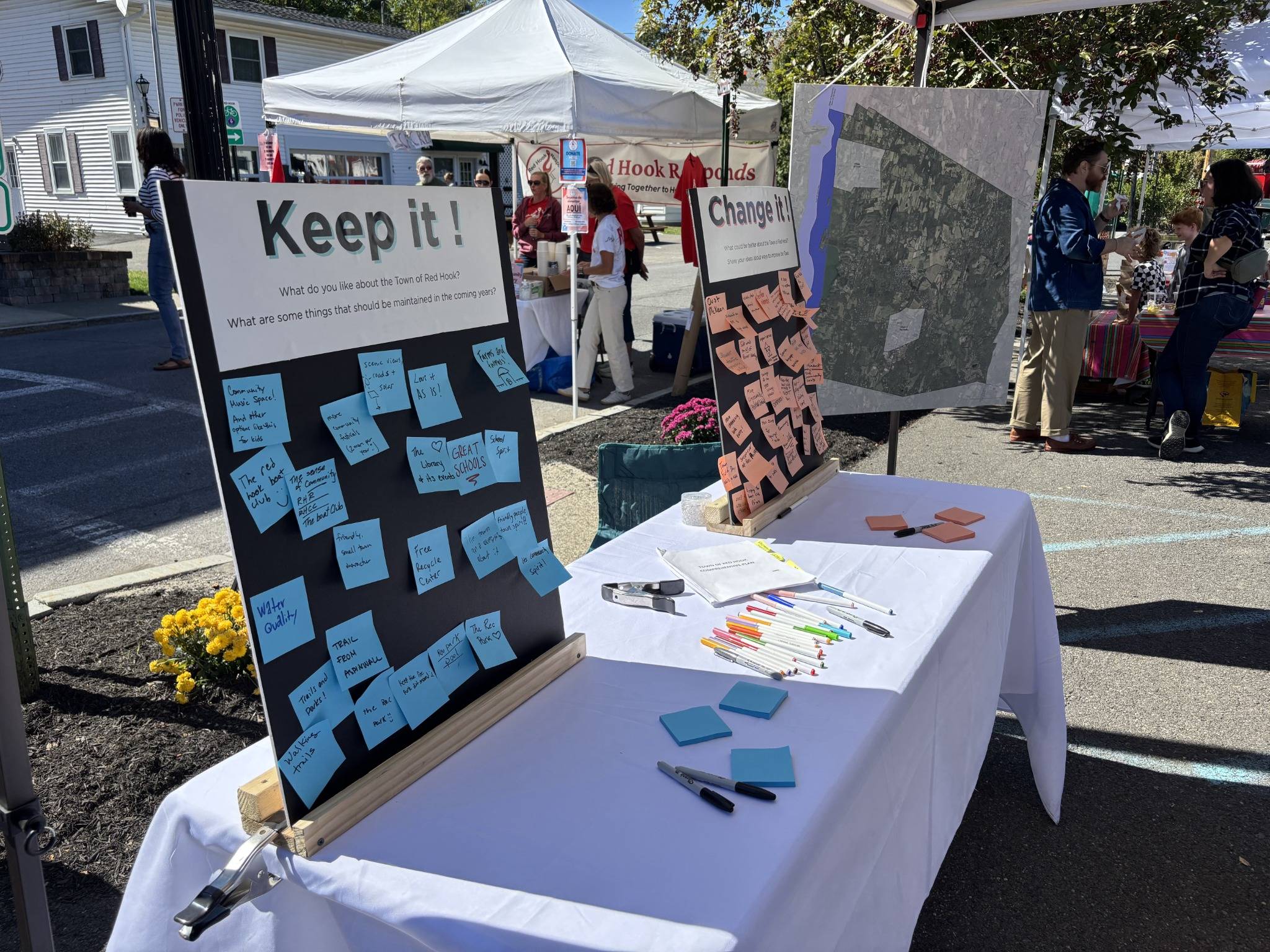
The current phase focuses on building a collective vision by gathering community input on what to preserve, improve, or achieve in the long term. On October 21, the town held its Vision Workshop, facilitated by Pattern for Progress and municipal representatives at the Red Hook High School cafeteria. Participants shared what they hoped to change or enhance in the town.
Many comments reflected a desire to foster a stronger “community spirit,” maintain green spaces, and “create more walking trails.” The push for a more walkable and connected town was echoed throughout: calls for more pedestrian crossings, community events, and opportunities for neighbors to connect more frequently.
While the first workshop drew around 80 participants, the ongoing challenge is reaching those who do not typically attend municipal events — including Latino families, immigrants, speakers of other languages, youth, seniors, and residents who have never participated in local civic processes. To reach them, the committee offers anonymous bilingual surveys (Spanish and English), translated materials, language interpretation when needed, and informal formats like “kitchen table conversations.”
This last method proved highly successful in the Rhinebeck Comprehensive Plan, completed in 2024 and awarded “Best Comprehensive Plan” by the New York State Planning Federation. That plan emphasized expanding green spaces, affordable housing, climate resilience, and local economic support — priorities that also resonate in the early stages of Red Hook’s plan and inspire the use of similar community engagement methods.
The “kitchen table conversations” model allows for small, culturally accessible discussions, especially for families who do not feel represented in formal settings. “The format is informal, small, comfortable — it works best for people who don’t usually attend town events. The host simply reports who participated, and we trust the community’s good faith,” Solomon explained. She also emphasized that language is not a barrier: the town will accept contributions in Spanish or any other language and will provide translations when needed. Any Red Hook resident can host a meeting in their home.
Solomon also stressed that no immigration or personal data will be requested, and that even the automatic collection of IP addresses was removed from online surveys to protect participants’ privacy.
Challenges and Opportunities
Solomon anticipates two major challenges: sustaining engagement throughout a nearly two-year process, and navigating complex regional issues — such as affordable housing, transportation for non-drivers, and climate resilience — at the local level.
At the same time, she believes the process can strengthen the town’s social fabric by fostering interaction among residents with diverse experiences, languages, and perspectives. “What matters most is talking with each other — not just with those who look like us,” she said, emphasizing dialogue as a tool for community cohesion.
Those wishing to participate can complete the vision survey, attend upcoming public workshops in spring 2026, or request information to host a conversation in their own space.
Resources
Spanish survey: https://es.surveymonkey.com/r/RedHookVisionEspanol
Notifications for upcoming workshops: https://www.redhookny.gov/list.aspx
General inquiries: [email protected]