

Cultura y noticias hispanas del Valle del Hudson


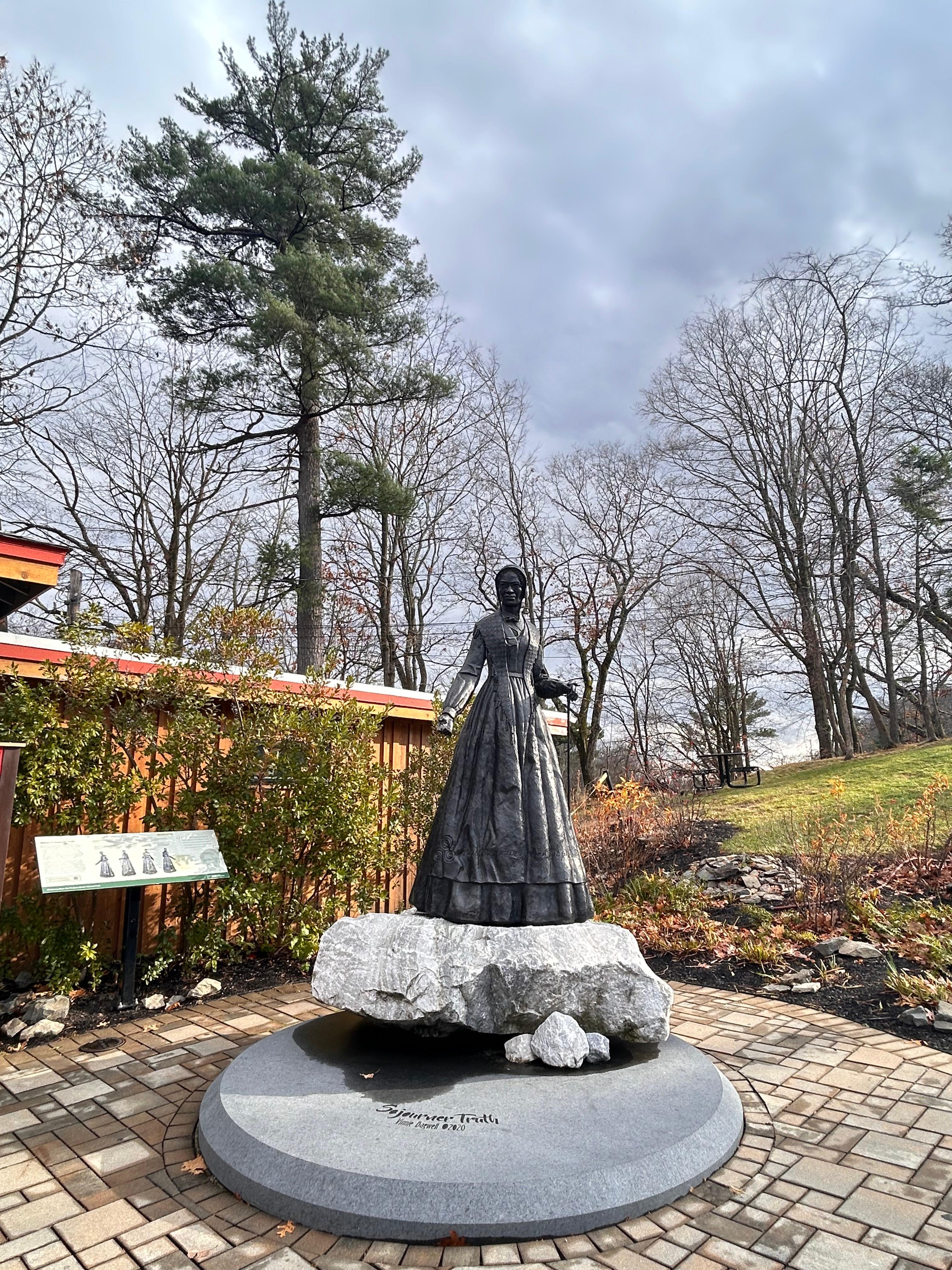
Its recent appearance, along with other monuments of historic women such as the Women’s Rights Pioneers Monument in Central Park and the Boston Women’s Memorial, came, as Vassar College Political Science professor Katherine Hite put it, “while activists across the country and the world are mobilizing to remove white supremacist monuments.” According to Hite, it “represents a hopeful turning point, a monumentalization appropriate for the here and now.”
Many admire the statue without realizing how unique it is. According to a 2021 report, in the United States only 6%—or 3 out of the 50 most represented people in monuments—are women. With this statistic, Chilean-German architectural historian Valentina Rozas-Krause opened her free lecture at Bard College about her research on the feminist transformations of “uncomfortable” or “difficult” monuments during Chile’s 2019–2020 social uprising.
Rozas-Krause is an Assistant Professor of Latin American and Global Architectural History at the University of Michigan. She was also a Frieda L. Miller Fellow at Harvard’s Radcliffe Institute for Advanced Study and held the Keith Haring Fellowship in Art and Activism at Bard College — the position that brought her to the Hudson Valley.
The professor has studied monuments in public spaces first through architecture and later through history, exploring how cities reflect structures of power and memory through public art. This work led her to co-edit Breaking the Bronze Ceiling, a book that analyzes how women have been represented — and erased — in monuments and urban environments. The book reveals patterns of inequality across societies and offers an innovative perspective on gender, memory, and power in the construction of heritage.
On this subject, Wendy Lockman, an African-American woman living in Poughkeepsie, shared that she visits the Walkway several times a week and always looks forward to her “Moment of Truth,” when she pauses to admire the statue of Sojourner Truth. “Her legacy and historical importance give me motivation and inspiration for the personal, social, and professional aspects of my life. She pushes me to fight for my goals, and I’m grateful to stand on her shoulders,” said Lockman with a smile.
Unfortunately, statistics show that statues of women are vandalized and sexualized more often than others, and they are also heavily criticized for being too suggestive, unrealistic, historically inaccurate, artistically uninspired — the list goes on. “There’s clearly a problem with these monuments and the way we talk about them,” says Rozas-Krause, explaining that the issue lies in how female bodies are represented in public space. “It seems like there’s no way to win — as women, we’re either not there, or if we are, we’re harshly criticized.” In her interview with La Voz, Rozas-Krause explained that these new monuments still fail to reflect a modern vision of women’s struggles, which means “the world of monuments is decades behind feminism.”
SUBTITLE: The Chilean Case
In her most recent research, Rozas-Krause studied Chile’s 2019–2020 social uprising, when massive protests erupted across the country in response to deep social inequality, the lack of social rights, ongoing colonial legacies, state violence, and the oppression of Indigenous peoples, among others.
Historians call this period the first major wave of monument uprisings, as statues were painted, decapitated, graffitied, destroyed — and sometimes danced around — while new monuments were erected. Protesters also targeted gender inequality, with a 2021 survey revealing that in Chile only 4.7% of monuments are dedicated to women.
But even traditional female representations can be uncomfortable depending on the narrative they portray. For example, many statues of Queen Isabella I of Spain in the cities Rozas-Krause studied were defaced, graffitied, and splattered with red paint in protest — only to later be restored.
One of the most famous cases is the statue of General Baquedano, erected in 1928 in Plaza Italia, Santiago’s main site of protests. This figure, considered a national hero for his military victories, represents for many the official history that glorifies war while silencing other voices, such as those of the Mapuche people and other victims of state repression. During the protests, the monument was repeatedly painted, cleaned, and reinterpreted from various political perspectives, including feminism. After these events, the statue was removed for restoration and later placed in the Historical and Military Museum. The square is now popularly known as Plaza Dignidad (Dignity Square), though it still retains its official name, Plaza Baquedano or Plaza Italia. In June, Chilean President Gabriel Boric supported returning the statue of General Baquedano to the square, where it would stand alongside a new statue of Gabriela Mistral.
However, Gabriela Mistral’s representation has also faced criticism. Despite being a beloved figure in Chile for her literature and Nobel Prize, she is often depicted with masculine features or as a mother — even though motherhood was not a central part of her public life. This reflects the ongoing issue of how historical women are represented.
Rozas-Krause also found that female allegorical and ornamental figures — often imported from France — dominate Chilean cities’ public spaces, while statues of real historic women are rare. These catalog-style statues typically adorn parks and plazas, emphasizing beauty over meaning. There are also abstract female forms showing only parts of the body, or paradoxical monuments of women dedicated to men, such as the recent Monument to the Women of the Men of the Sea. These statues do not serve as acts of memory in the way male monuments often do.
As a historian, Rozas-Krause emphasizes that her work aims to ensure that this and future generations understand that while some monuments are truly unacceptable (as she quips, “no one would dare place a statue of Robert Livingston on the other side of the Walkway”), in general, every public monument is subject to critical reflection and public debate. What if a monument becomes one of the “uncomfortable” ones? There is no universal formula, she says, but she offers some ideas: public debates, creative strategies for transformation, re-labeling, or the inclusion of modern artistic visions — all ways to build a shared memory that more accurately represents the communities depicted.
“It’s not about creating a bunch of catalog-bought statues of women just to improve the numbers,” Rozas-Krause insists. “We need a compelling language to represent historical women, but also the diversity of dimensions we embody as women — we are scientists, mothers, artists, daughters, politicians, and so many other facets that deserve representation.”
back to topComments | |
| Sorry, there are no comments at this time. |